.svg)

SS Spotlight
Your Building Assessment Isn’t a Transaction — It’s Your Operating Plan

Most building assessments happen once. Someone buys a property, a lender requires a property condition assessment, an engineering firm walks the building, and a report lands in a file. It documents the obvious — the roof’s age, the boiler’s condition, a punch list of deferred maintenance items — and then it sits there. Maybe it resurfaces during a refinance or a sale. Most of the time, it doesn’t resurface at all.
That’s a waste of the most useful tool a property manager can have.
A building assessment shouldn’t be a transaction checkpoint. It should be the document that tells you how to operate your building. It should be the thing you open when you’re deciding whether to replace those air handler filters this month or next quarter. The thing you reference when ownership asks why you’re requesting budget for emergency lighting repairs instead of parking lot resurfacing. The thing that takes the guessing out of what to prioritize when everything feels urgent and the maintenance budget isn’t getting any bigger.
The problem is that most assessments aren’t built for this. They’re built for lenders and transaction due diligence. They follow standards designed to evaluate whether a deal should close, not to tell a property manager what to do on Monday morning. The reports are thorough in the engineering sense — every system cataloged, every component aged — but they don’t prioritize. They don’t tell you what’s actually urgent versus what’s documented and fine. They don’t connect to the maintenance work that has to happen this week.
Property managers running multifamily buildings know this gap intimately, even if they’ve never named it.They’re managing buildings where the maintenance history is incomplete or nonexistent, where the previous owner deferred everything that wasn’t an emergency, and where every decision about what to fix and when is made based on gut instinct and whoever’s complaining the loudest. That’s not a maintenance strategy. That’s survival mode.
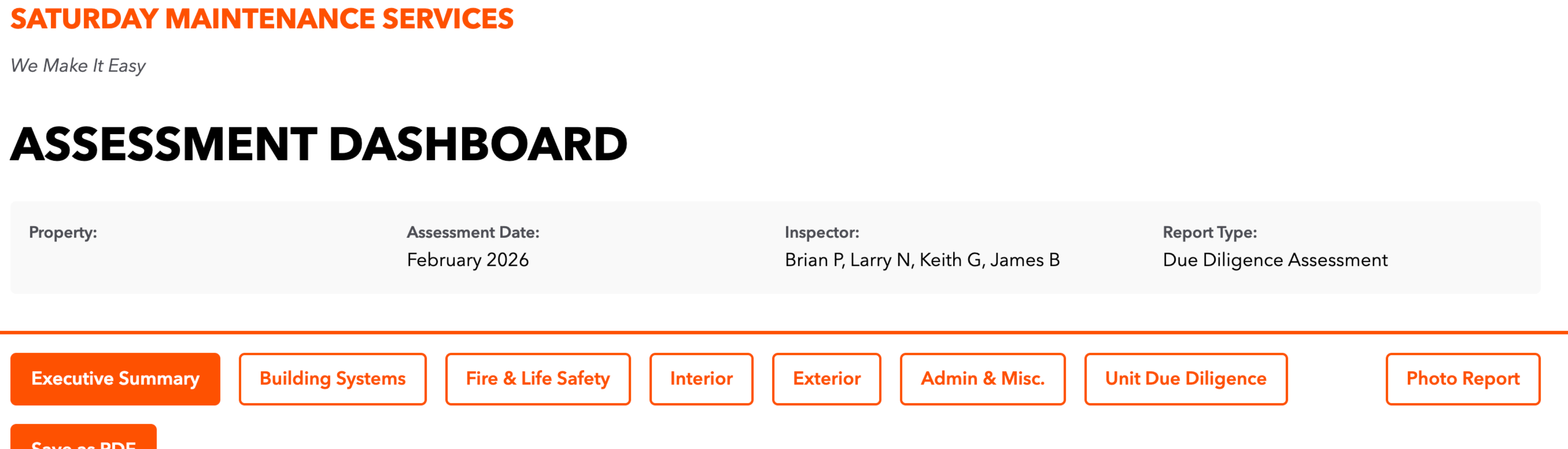

An operational assessment changes this. When every finding is classified by real priority — what needs immediate attention, what should be addressed within thirty days, and what’s in good condition — the property manager suddenly has a framework for decisions instead of a stack of unknowns. The HVAC filters that haven’t been changed in six months are flagged alongside the floor drains that need mineral oil treatment and the exit lights that are a life safety compliance issue. Each one gets a clear priority, and the property manager can sequence the work instead of reacting to it.
At Saturday Maintenance Services, our building assessments cover seven systems — HVAC and mechanical, fire safety and life safety, plumbing, building cleanliness and housekeeping, exterior and grounds, building systems and documentation, and unit-by-unit conditions. Every item gets photographed, documented, and assigned a priority. The result isn’t a report you file. It’s a dashboard you use.
That dashboard becomes the operating plan. It feeds directly into preventative maintenance schedules — which filters to replace on what cadence, which drains to flush quarterly, which seasonal items to calendar before Minnesota winter arrives. It gives ownership a clear, visual picture of where the building stands, organized by system and priority, so budget conversations start with evidence instead of estimates. And it creates a documented baseline, which means next quarter’s walkthrough can measure improvement instead of starting from scratch.
The buildings that retain their value overtime aren’t the ones that got lucky. They’re the ones where someone knew what was inside them, made a plan, and followed through. An assessment that lives on your desk — not in a drawer — is where that starts.
If you’ve never had a building assessmentthat you actually used after the first week, it might be worth asking whetherthe problem was the building or the assessment.
Service, Solve, Never Stop!